THE ESSENCE
The Serengeti is not merely a national park. It is the archetype—the savannah of every childhood documentary, the landscape that defines “African safari.”
Its name derives from the Maasai siringet: “the place where the land runs on forever.”
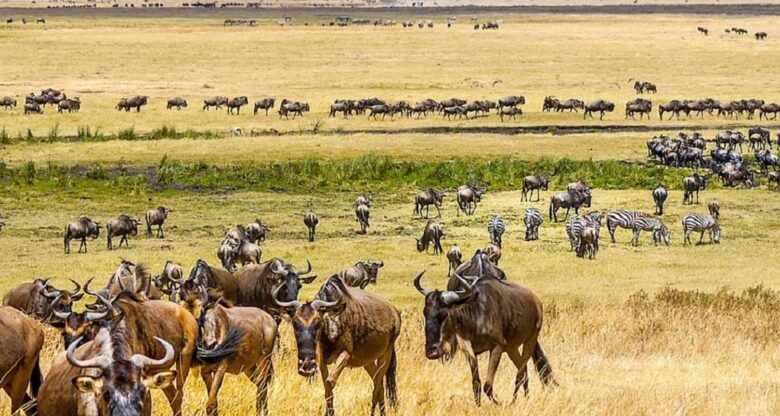
This is not hyperbole. The Serengeti ecosystem spans 30,000km², stretching from northern Tanzania into Kenya’s Masai Mara. Its grasslands host the Great Migration—over 1.5 million wildebeest, 200,000 zebras, and 500,000 gazelles—the largest overland animal movement on earth.
But the migration is only part of the story. The Serengeti is also Africa’s premier predator destination. Lions, leopards, cheetahs, hyenas—nowhere else offers such consistent, intimate encounters with big cats.
To visit the Serengeti is to understand why we fall in love with Africa.
WILDLIFE
| Species | Population | Sighting Probability |
|---|---|---|
| Wildebeest | 1.5 million+ | 100% |
| Zebra | 200,000+ | 100% |
| Thomson’s Gazelle | 500,000+ | 100% |
| Lion | 3,000+ | >90% |
| Leopard | ~1,000 | 60-70% |
| Cheetah | ~500 | 50-60% |
| Spotted Hyena | 8,000+ | >95% |
| Elephant | 5,000+ | High |
| Buffalo | 50,000+ | High |
| Giraffe | 10,000+ | High |
| Hippo | 4,000+ | High (Retina Pool) |
| Crocodile | Abundant | High (Grumeti, Mara) |
| Black Rhino | ~100 (Moru Kopjes) | Rare |
Birdlife: Over 500 species, including Ostrich, Kori Bustard, Secretary Bird, and Martial Eagle.
MIGRATION: 1.5 MILLION+ WILDEBEEST
PREDATOR DENSITY: AFRICA’S HIGHEST
AREA: 14,763km² (TANZANIA’S LARGEST)
UNESCO STATUS: WORLD HERITAGE SITE (1981)
THE GREAT MIGRATION: MONTH-BY-MONTH
| Months | Location | What Happens | Crossing Probability |
|---|---|---|---|
| January–March | Southern Serengeti / Ndutu | Calving season — 8,000 wildebeest born daily | Low |
| April–May | Southern / Central Serengeti | Long rains, herds disperse | Low |
| June | Western Corridor / Grumeti | First major river crossings | Moderate |
| July–August–September | Northern Serengeti / Mara River | Peak crossing season | High |
| October–November | Northern Serengeti / Return south | Crossings continue, then southward journey | Moderate |
| December | Southern Serengeti | Calving begins again | Low |
Optimal Migration Viewing:
- Calving: January–February (Southern Serengeti/Ndutu)
- River Crossings: July–September (Northern Serengeti/Mara River)
REGIONS
| Region | Landscape | Signature Wildlife | Best For |
|---|---|---|---|
| Southern Serengeti / Ndutu | Short-grass plains | Calving season (Jan–Mar) , cheetah, lion | Births, predators |
| Seronera Valley (Central) | Riverine, kopjes | Lion, leopard, cheetah — year-round | Predators, first-time visitors |
| Western Corridor | Grumeti River | Grumeti River crossings (June–July) , crocodile | Migration, fewer crowds |
| Northern Serengeti | Rolling hills, Mara River | Mara River crossings (July–Sept) , elephant | The crossing |
| Lobo Valley | Wooded hills | Lion, leopard, elephant | Dry season refuge |
| Moru Kopjes | Granite outcrops | Black rhino, lion, klipspringer | Rhino tracking |
SIGNATURE EXPERIENCES
| Experience | Duration | Best Time | Highlights |
|---|---|---|---|
| Hot Air Balloon Safari | 1 hour flight + champagne breakfast | Dawn | Aerial migration view, Serengeti at sunrise, once-in-a-lifetime |
| Mara River Crossing Watch | Full day | July–September | Crocodile ambush, wildebeest plunge, raw survival |
| Calving Season Safari | Full days | January–February | 8,000 births daily, predator action, newborns |
| Kopjes Exploration | 3-4 hours | Morning/evening | Lion on granite, klipspringer, hyrax, panoramic views |
| Night Game Drive | 2-3 hours | After sunset | Nocturnal species (limited to private concessions) |
| Walking Safari | 2-3 hours | Morning | Eye-level perspective, tracks, dung, plants (private concessions) |
WHEN TO VISIT
| Season | Months | Conditions | Migration Location | Recommendation |
|---|---|---|---|---|
| Peak | July–October | Dry, animals concentrated | Northern Serengeti / Mara River | ★★★★★ |
| High | January–February | Short dry, calving | Southern Serengeti / Ndutu | ★★★★★ |
| Shoulder | June, November | Transitional | Western Corridor / Scattered | ★★★★☆ |
| Green | March–May | Long rains | Dispersed | ★★★☆☆ |
| Avoid | April–May | Heavy rains, roads challenging | Dispersed | ★★☆☆☆ |
ACCCOMMODATION STYLES
| Style | Examples | Position | Best For |
|---|---|---|---|
| Luxury Permanent | Four Seasons, &Beyond, Singita, Asilia | Prime locations | Discerning travellers, honeymoons |
| Luxury Mobile Camp | Nomad, &Beyond, Asilia | Migration-following | Ultimate migration experience |
| Mid-Range Lodge | Serengeti Heritage, Katikati, Pamoja | Central, Western, North | Value-comfort balance |
| Budget Camp | Serengeti Wild Camp, Tanzania Bush Camp | Various | Budget-conscious travellers |
| Public Campsite | Seronera, Lobo, Ndutu | Inside park, basic | Authentic wilderness, adventurous |
ESSENTIAL INFORMATION
| Detail | Information |
|---|---|
| Established | 1951 |
| UNESCO Status | World Heritage Site (1981) |
| Area | 14,763 km² |
| Ecosystem Area | 30,000 km² (with Masai Mara) |
| Altitude | 920m – 1,850m |
| Annual Rainfall | 500mm – 1,200mm |
| Temperature | 15°C – 30°C (cool at dawn) |
| Nearest Town | Arusha (5-6 hours), Karatu (4-5 hours) |
| Nearest Airports | Seronera, Lobo, Kogatende, Ndutu (charter) |
| Gate Entry | Naabi Hill (main), Ndabaka, Klein’s, Bologonja |
TIPS
- Timing is everything — Research migration patterns before booking. July–September for Mara crossings; January–February for calving.
- Stay in the right region — The Serengeti is vast. A 3-night stay in Central will not allow you to reach the Mara River. Choose your region based on season.
- Consider a mobile camp — Migration-following camps move with the herds. This is the ultimate Serengeti experience.
- Book the balloon safari — Expensive but unforgettable. The champagne breakfast in the bush is iconic.
- Stay at least 3 nights — Serengeti rewards patience. Two-night stays feel rushed.
- Pack warmly — Dawn game drives are cold. Fleece, jacket, hat.
- Combine with Ngorongoro — The classic Northern Circuit pairs Serengeti with Ngorongoro Crater. Do not skip the crater.